You’re Not Here to Make Life Harder for Others
Those of you who have read my About page know I'm an old geezer. I probably don’t have any of the credentials you might look for in a source of life advice -- other than that my path through life has likely been longer, and definitely different, than yours. Along the way, I may have stumbled upon nuggets of wisdom you haven't yet.

Friends s10e06 - The One With Ross's Grant
Joey Tribbiani over-acting being an old man
I’d like to share them with you; I hope they’ll resonate. Let’s start with #1:
You’re not here to make life harder for others
Subreddits like r/pettyrevenge and r/maliciouscompliance are popular and may make you think that revenge is entertaining and funny, and I admit that sometimes it is. But...
What’s the dish?
“Revenge is a dish best served cold” is often taken to mean you should act without remorse, and take your time to plan it carefully to minimize the repercussions.
But then revenge isn’t just a moment -- it’s become a process. The longer you "let it cool", the longer you’re carrying it around: replaying the slight, refining the response, feeding the anger. You’re investing time and attention into something negative, and that investment doesn’t stay contained. It shapes how you think.
You’ve probably heard fake it till you make it or what you feed, grows. That applies here too. If you keep anger and vindictiveness in focus long enough, they stop being reactions and start becoming habits.
By the time the dish is ready, it’s not just revenge you’ve prepared -- it’s a slightly more bitter version of yourself.
When feeling invisible turns to revenge
Quite soon after it was published online, many years ago, I saw a TED Talk by Tony Robbins and I’ve always remembered two fragments from it: the funny one where Al Gore explains why he lost the election, and, in the context of this blog post, a more important one where Robbins argues that people crave significance. He says:
The fastest way [to feel significant], if you have no background, no culture, and no belief in resources or resourcefulness, is violence. If I put a gun to your head and I live in the hood, instantly I am significant. Zero to ten, how high? Ten. How certain am I you’re gonna respond to me? Ten.
That idea has always explained a lot of human ugliness for me. If you feel unseen, powerless, or ignored, it’s not hard to understand how violence or vindictiveness can start to look like a shortcut to significance.
Try to imagine someone who is petty, vindictive, or violent. I suspect the image that pops into your head isn’t of a generous person living a rich, fulfilling life, but of someone who struggles to feel seen or valued on their own terms [1]. It’s even hinted at by the name of the aforementioned subreddit, malicious compliance: the person who complies is at the lower end of a power gradient and does as they are told, usually against their will; their malicious behavior is a way to avenge their powerlessness.

Buffy the Vampire Slayer s01e11 - Out of Sight Out of Mind
Marcie Ross is ignored by everyone and magically becomes invisible -- and vindictive
So, why not get even?
When I think back about the 1980s nighttime soap "Dallas" (yes, I’m that old), what sticks with me is the tiresome cycle of J.R. Ewing cheating Cliff Barnes in a business deal and arranging a meeting just so he could rub it in and gloat. Barnes takes revenge, to which J.R. responds in kind, etc. It was a very popular show at the time, and I wonder to what extent it popularized or normalized taking revenge. To me, it highlighted why to abstain from it.
One of the many problems with revenge stems from the balance of power.
If they’re weaker, it looks like bullying.
If they’re stronger, it backfires.
If you’re evenly matched, it escalates.
None of these end well.
Another problem is that when you avenge the wrongdoings of other people, you allow them to discover how to push your button, which makes you easier to manipulate. (Some have argued that the current political landscape was sculpted by social‑media‑induced rage.) Ask yourself: if someone provokes or insults you, what exudes more inner strength: insulting them back, or smiling genuinely and continuing with what you were doing?
Don't let it stick
Your life becomes a lot easier when you don’t react to provocations. Don’t let anything stick to you. To quote Ted Lasso:
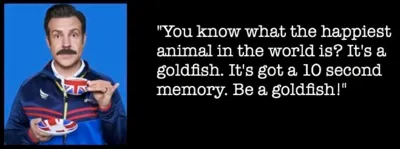
Be a goldfish; they only have a 10 second memory
You don’t need to take my word for it! Research on anger rumination shows that taking revenge is actually bad for everyone. See the Footnotes [2][3][4].
The key idea here is that you can choose how to deal with an insult or punishment, and that choice changes how much power the other person has over you.
I was still quite young, maybe 8 or 9, when I realized that a punishment isn’t a punishment when you don’t consider it one. Another way of saying this is: punishment is mostly inside your head, and (sometimes after some practice) you can control what goes on there. Don’t allow yourself to suffer from punishment, and you take away any benefit that the person punishing you could get. The same line of reasoning goes for insults.
All this doesn’t mean you have to become a pushover. Just keep in mind that in most modern societies, there are better ways to escalate problems you have with other people: the HR department of a company, or the authorities, to name two.
The other side
Not inflicting misery on other people is one step, but there are other ways to improve the lives of other people. Big gestures make the news, but you don’t need to clean up the ocean to have an impact. A lot of good you can do goes completely unnoticed.
When you go for a walk and notice waste on the shoulder of the road, pick it up and throw it in a bin. Birds would thank you if they could.
If after a storm a big branch is laying on a bike path, throw it aside so distracted cyclists won’t hurt themselves.
When your significant other often misplaces their keys and you find them in an unusual spot, move them to an obvious place where they can easily be found.
There are probably dozens of little things you can do every day to improve the lives of other beings, even if they never find out about it. You won’t get credit (karma, maybe, if you believe in that), but there’s an upside: you feel good when you do these small things, but you don’t feel bad when you don’t. You’re not under scrutiny to be good all the time, and that’s liberating!
Conclusion
After reading this blog post (thanks!), I could understand if you arrived at the conclusion that I’m arguing you should be nice to other people. Although it’s true that you should be, if that was my entire point, I would have saved you and me some time and referred you straight to the teachings of Mr. Rogers, Keanu Reeves, or even dr. Bernadette Rostenkowski.
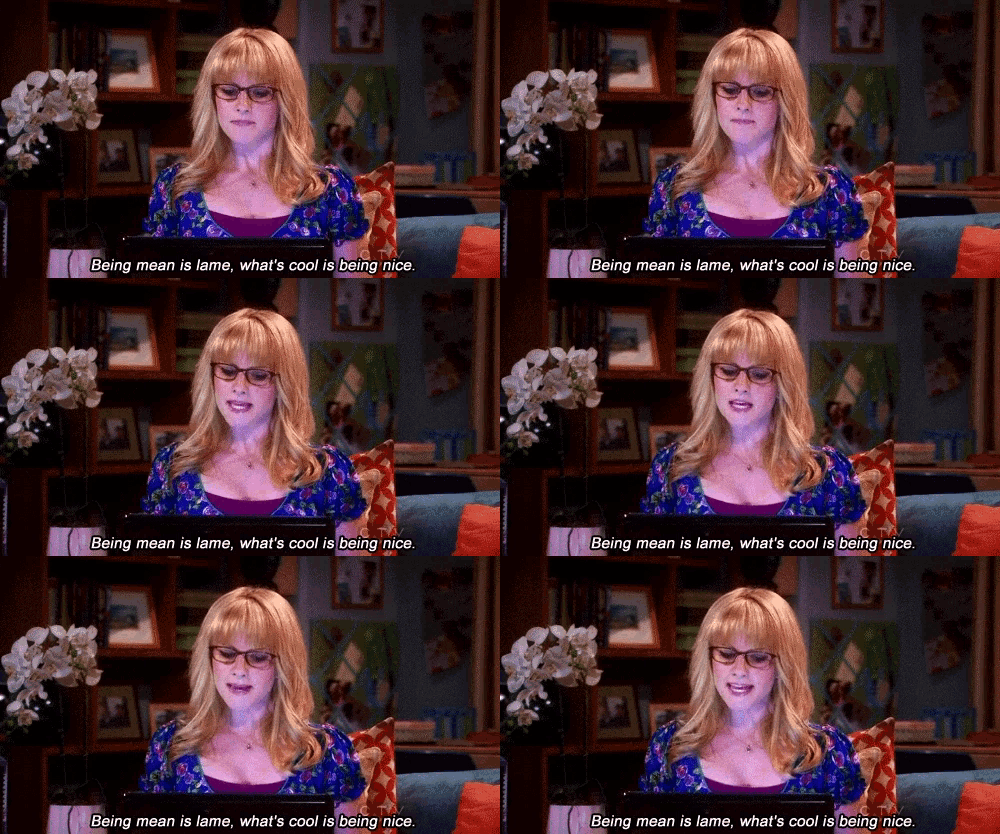
The Big Bang Theory s06e02 - The Decoupling Fluctuation
Dr. Bernadette Rostenkowski making a point in favor of being nice
Revenge may feel like power, but it’s often just people advertising that they feel small. It’s easier to feel significant when you’re making someone else flinch than when you’re peacefully refusing to take the bait. The takeaway: don’t invest in revenge when you can invest in modest, quiet acts of help. You’ll save time, skip the resentment, and still come out on the right side of the story -- without needing an audience to notice.
And hopefully, you’ll end up doing it not because it’s what everyone else wants from you, but because you’re convinced it’s who you want to be.
Footnotes
[1] President Trump seems to have it all, but clearly craves more (e.g., a Nobel Peace Prize); he is, therefore, not valued on his own terms. Although there is still a good chance that once he does have everything he craves, he'll still be an exception to the rule.
[2] Regulating responses to anger: effects of rumination and distraction
[3] All in the mind’s eye? Anger rumination and reappraisal
[4] The dark triad and forgiveness: The mediating role of anger rumination