The Hedonic Treadmill Needs a Steering Wheel
I'm currently reading the book Moral Ambition by Rutger Bregman [1]. Chapter 7 begins by discussing how much better life is for humanity today than it was a few centuries ago. At the top of page 124 it reads:
The share of the world's population that lives in extreme poverty has gone down nearly 90 percent, and the poor in wealthy countries now enjoy a higher standard of living than kings and emperors did a few centuries back. [2]
Bregman sees this progress as proof that humanity can solve massive problems when it aims high. But while this is truly inspiring and likely accurate, I can't help being saddened by the statement's implications. We rarely experience our lives against the backdrop of past centuries; we experience them against the lives of people around us now -- especially those visibly above us on the social ladder. No matter how much progress we make, or how good our lives become within a historical context, that comparison leaves us continuously susceptible to discontent.
This is understandable: we are taught about past plagues, financial crises, etc., but learning about the misery they caused is hardly the same as experiencing it yourself, making it easy to inflate our own hardships. And this isn't even completely negative: our perpetual desire for a better life, also known as the hedonic treadmill / hedonic adaptation [3], may be a driving force behind a lot of progress. The real problem lies in how our dissatisfaction is channeled.
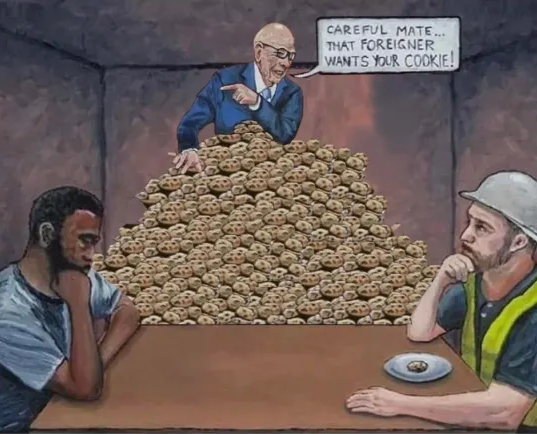
In the past ten years or so, I've seen several variations of this cartoon online: a clearly very rich man with many cookies in front of him, telling a worker with only one cookie to be "careful: that foreigner wants your cookie," while pointing at an immigrant with no cookies at all.
Each time, I was briefly amused but mostly glossed over it. Until I came across it once again after just having read the above quote from Bregman's book -- and a few books on fascism in the weeks before it. Then I realized: only a tiny amount of the money the middle class makes trickles down the societal ladder; the vast majority of it goes up in a torrent, adding to the immense wealth of oligarchs and poorly regulated companies. And yet, political demagogues worldwide manage to exploit the resulting anxiety by convincing people that immigrants and refugees --those on the lowest rungs of the ladder-- are to blame.
How does this trick work so consistently? How do the powerful manage to pit the working class against the disenfranchised? Media ownership and narrative control [4] [5] certainly play a role, but even given those circumstances, the fundamental truth should still not be hard for everyone to see: people suffer far more from exploitation by the top 1% than from competition with the ones beneath them. Economic insecurity creates a search for explanation; populist actors redirect that anxiety toward immigrants, minorities, and other vulnerable groups, rather than toward the actual reasons: unequal power, wages, housing costs, and tax policies.
When I first started reading modern books on fascism [6], I assumed that term was just being used as a convenient, inflammatory rhetorical label for modern populist politics. But works that precede the current worldwide political landscape [7] already identified recurring fascist techniques:
- manufacture a pure, "people" with a great, mythical past that we should return to
- identify internal (preferably easily-identifiable) enemies
- portray democratic institutions, the press, academia as weak or corrupt
- offer a strong leader as the solution
If we want to build the kind of ambitious world Bregman envisions, our first step must be recognizing where our discontent is being weaponized, and who truly benefits when we look down instead of up.
A treadmill doesn't come with a steering wheel; we'll have to build one. The machine will keep us running, but we get to choose the direction.
[1] Moral Ambition, by Rutger Bregman, translation Erica Moore, ISBN 978-1-5266-8559-9
[2] The book references Extreme Poverty: How Far Have We Come, How Far Do We Still Have To Go? by Max Roser, Our World in Data (27 August 2023) for this statement.
[3] Jimmy Carr describes this phenomenon.
[4] https://www.foxbusiness.com/technology/elon-musks-ai-company-buys-x-blockbuster-33b-stock-deal
[5] https://www.foxbusiness.com/markets/jeff-bezos-to-buy-washington-post-publishing-business
[6] How Fascism Works: The Politics of Us and Them, by Jason Stanley, ISBN 978-0525511854
[7] A History of Fascism, 1914–1945, by Stanley G. Payne, ISBN 978-0299148744