Shallow Observations
A while ago, a video showing the ("deadly stunning," as the video calls them) partners of Formula 1 drivers showed up in my YouTube Shorts feed. As I often do, I watched the video and checked out the comment section sorted by "Newest".
I don't mean to brag 😉, but before I started reading, I already expected the following types of comments:
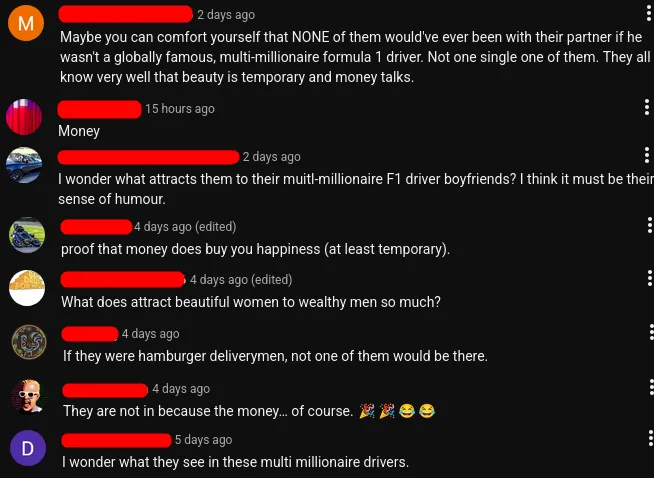
Now, I can't look into the minds of the commenters (who are, probably, mostly men), but I suspect the underlying sentiment reflects varying degrees of jealousy. "Why do these gorgeous women only go for rich men and not for a sweet, normal guy [1] like me?" Yes, they may also simply be trolling or making the obvious joke, but the fact that this was apparently the most entertaining angle they could come up with is, perhaps, telling. Also, I've come across men IRL who expressed similar complaints; it's apparently not an unusual sentiment.
This blog post is anecdotal and based on personal observations. I haven't done much research on the topic.
In an episode of How I Met Your Mother [2], the theory of Reachers and Settlers is explained. It says that many couples consist of one person (the reacher) who is trying to get a partner with a value higher than their own, and one person (the settler) who will accept a partner that has a lesser value.
It's natural to go for the best partner you can get. In practice, finding an optimum can be difficult and time-consuming. People may therefore "settle" for someone with a position in the dating market (which I'll simply call "value") that is close enough to their own. The desire to find the best mate may make someone who is a 6/10 reach for a 9/10, but this 9/10 person would be selling themself short if they settled for anything less than, say, an 8/10.
Counterintuitively, exceptionally attractive people don't always have an easier time finding lasting relationships. On closer inspection, this is not that surprising. Like so many traits, beauty follows the bell curve: most people are average-looking, with extremes in both directions. This means that beautiful partners are rare, so the pond in which beautiful people can find equally attractive partners contains far fewer fish. Ironically, a high-value partner who decides to settle in order to increase the number of potential partners may discover that those lower-value partners are hesitant to take the risk of not only the initial rejection, but also the higher risk of competition after the relationship has been established.
In the second half of the 1990s I very briefly did some temp work at a mobile phone company in Amsterdam. One of the other people who worked there was a really, really beautiful woman. I have this vivid memory of her leaning against a windowsill during a coffee break with a half-circle of five men standing around her. In modern terms: the situation was a bit cringy. Any man interested in the second most beautiful woman there would have had zero competition.
In case that anecdote makes you think 'Beautiful people have it easy,' I have another one for you:
After the dot-com bubble burst in the early 2000s, I was lucky enough (work was hard to come by) to have a friend who was a senior manager at a software company in Leiden. He gave me some contract work to do for them which tided me over for two years.
As I worked there, he conducted interviews for a position. One of the applicants was a very, very beautiful and qualified woman. He did not hire her. When I asked him why not, he answered: "Do you have any idea how distracting it'll be to have someone that beautiful as a colleague?"
The ability to produce great offspring is one thing; raising that offspring to adulthood is another. It requires resources. When it is hard for a beautiful woman to find a partner who is physically as attractive as she is, selecting a partner based on their solvency may offer the flexibility for her to still end up with a partner from the same "desirability bracket." From that perspective, it's natural that beautiful people and rich people fish in the same pond: they both bring something to the table that is valuable to the other. Given that wealth and beauty both have value, and that both parties knowingly bring something the other desires, it's striking that the beautiful partner is so often dismissed as a gold digger, while the wealthy partner is more often portrayed as either fortunate or foolish than as morally suspect.
Earlier I mentioned knowing a few men who lamented that unusually beautiful women were not interested in them. They were good guys, but regular Joes. Nothing special. (Well, I guess pretty much anyone is special to someone.) On one such occasion, the "Joe" involved was widely known to like (women with) big boobs. He complained that some famous big-boobed model would never be interested in him because he had no money, "even though I would treat her very well." Now, the sad thing was that he said this in the presence of a small-breasted woman whom I knew had a thing for him. I wondered to what extent her thoughts mirrored his. "He will never be interested in me because I have don't have big boobs, even though I would treat him very well."
I grew up in a small village; everybody knew everybody. My mum was waiting in line at the local greengrocer's when a woman my age approached her.
"Aren't you 4s's mother?"
"Well, yes, I am."
The woman introduced herself, and said:
"In primary school I used to be bullied a lot, and 4s would always stand up for me."
When my mum told me about this (all this happened when I was well into my 30s, possibly even 40s) I knew who she was talking about. I don't remember standing up for her but I do remember her being nice to me: she once gave me some marbles to play with after I had lost all of mine in a game. Anyway, I was saddened a bit because even though we were nice to each other, I never really noticed her. I only had eyes for the most popular girl in school.
Looking back, maybe I wasn’t so different from the "regular Joes" I judged earlier. I, too, ignored someone kind and potentially compatible because my eyes were fixed elsewhere. I was only a ten-year-old, so the scale was smaller, the stakes lower, but the pattern was the same. The men in the YouTube comments likely wanted exceptionally attractive women to look past status and see them instead of Formula 1 drivers. Yet many of them struggle to look past physical attractiveness themselves. We all like to believe we're evaluating people on character, but when it comes to choosing a partner, our actions often reveal a more complicated set of priorities.
[1] Purposely avoiding the adjective 'nice' here.
[2] How I Met Your Mother, s05e13, Jenkins.