Red Pill, Blue Pill, Green Earth
A few months ago, I came across this meme on Reddit:
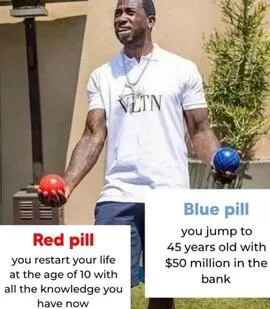
In case you have trouble viewing the details of the image (I feel your pain); it shows a man holding a red ball in one hand and a blue one in the other, with two options:
- Red pill: you restart your life at age 10 with all the knowledge you have now
- Blue pill: you jump to 45 years old with $50 million in the bank
Dilemmas very similar to this are published almost on a weekly basis on Reddit. Many responses revolve around how to optimize the amount of money one can make, going back to certain points in time.
Tip: if you ever happen to end up in 2009, you may want to buy $1 worth of Bitcoin as soon as possible after October 5th. Sell it on October 6th, 2025 for over $100,000,000. A decent gain for 16 years plus one day of twiddling your thumbs.
While you'retherethen (har, har) you should definitely also attend Stephen Hawking's Time Traveller Party↗!
Being not that far from retirement and having had a very good life so far, both the red pill option and the blue pill option coming true would make me do a triple backflip from joy (well, it would if I could) because either way, I'd be a lot younger, healthier and (end up) richer than I currently am.
Actually, the Blue Pill option has a catch: you don't get to retain knowledge so you may wake up at age 45 with $50 million in the bank, feeling like nothing special had happened. No moment of realization, no jumps of joy. Just another day.
(The meme likely was created with people younger than 45 in mind; a phrasing that would make the dilemma more interesting for all ages would be: "Blue Pill: you instantly age x years, but get $50 million in the bank.")
My mum used to say "Money doesn't bring you happiness; it just allows you to pick your own flavor of misery." With that in mind, whenever I come across a meme like the above, I choose to retain memories and/or go back in time as far as possible. Retaining memories is key; without that, there's no gain. (I might currently be re-living a life I've lived before but ignorant of it!) My memories would allow me to make money and navigate social obstacles such as teen peer pressure. Those bases are covered. The question then becomes:
How do I make the most of 'starting over'?
As you can gather from the name of my blog, the environment is important to me.
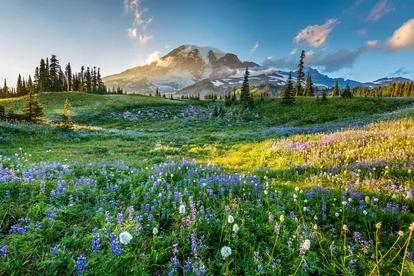
'The environment' is the air that we breathe, the water we drink, the source of most food we eat, the plants and animals whose existence we enjoy, the natural conditions we live in. Once degraded, it is almost impossible to fix. Therefore, the environment is of the utmost importance to everyone, whether they are aware of it or not.

It appeared to me that by far the best way I could make the most of going back to the late 1970s (when I was 10), is by fighting climate change. The question then became: How do I go about that?
The first idea that (almost immediately) popped into my head was: I could predict disasters, possibly prevent them, and gain credibility as someone who can tell the future which might cause people to listen to me when I tell them climate change is real and what we need to do to fight it.
The first disaster that came to mind was the 9/11 attack on the United States↗. At first glance, this was perfect: the USA leads the world and they are one of the largest polluters, so getting them to change course would have a huge impact.
It surprises me how people in the Western world point toward China when discussions about environmental responsibility arise. Americans often note that China pollutes more than the U.S.; although true, China’s population is also four times larger. Per capita, the U.S. population still pollutes far more.
This pattern of finger-pointing isn’t unique to the U.S. Here in the Netherlands people often say, "We’re too small to make a difference; it’s up to China." They conveniently forget that, per person, we’re far wealthier and we gained that wealth largely by exploiting the environment. It feels unreasonable to say, "We ruined the planet for our gain, but now it’s China’s job to fix it at their expense."
After giving this some thought, I realized that predicting 9/11 not only wastes 20 years that we could have worked on climate change, but also, it wouldn't work:
- even if I managed to get through to him, then-President G.W. Bush might not believe me, and even if he did, he might be in the pocket of Big Oil and nothing would change.
- instead, I could try to draw a lot of media attention predicting 9/11, but the terrorists should then also pick up on that and postpone or not execute the attack. Terrorist attack averted but climate change still in full swing, and I lost credibility.
- I could draw media attention to my prediction by publicly handing it to a notary in a sealed envelope before 9/11 and having it revealed after 9/11 [1]. However, letting almost 3,000 people die to make a point, even if it's for the greater good, is a bit of an ethical conundrum. If people believed it wasn't just a (tasteless) trick, it definitely wouldn't score me any popularity points.
Other disasters have the same problem: the event you predict has to be horrible or it won't receive much media attention, but if it's horrible you should prevent it -- and lose your opportunity to create earlier recognition of climate change.
I had already been writing on this blog post on and off for a few weeks when YouTube's algorithm suggested this video to me...
When I discussed this with my wife (how big of nerds are we, discussing hypotheticals like this?) she said: "How about the Chernobyl disaster↗?" That is probably as good as it gets: Chernobyl was at the time still firmly behind the Iron Curtain↗ and well outside my sphere of influence. If I managed to draw a lot of attention with my prediction, people with the influence to prevent it (party leaders?) would probably dismiss it as a Western anti-Soviet smear campaign » do nothing with the information » the disaster would still happen ("Yay"?) and I can wash my hands of it (ugh, that sounds awfully callous) » it might create awareness of climate change.
The key word there is: might. The disaster itself would overshadow the message and that would probably apply to any disaster. Also: this is the only "usable" disaster I could come up with, so if it fails to draw attention to climate change for whatever reason, I'd be back at square one, with no more arrows in my quiver.
I decided to ask a few AIs if they had any good ideas; they came up with "introduce legislation." As a ten year old??? It's as if they want me to walk to the nearby car wash↗ all over again.
'Global Warming'
I was considering my options when I realized that maybe I could at least prevent the term Global Warming from being coined. To this day, some climate change deniers continue to "confuse" the weather with the climate and, on cold weather days, jokingly lament the seeming absence of global warming.
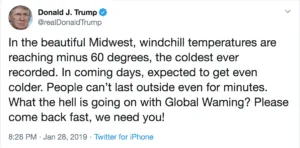
I remember learning about the rhetorical device of the "straw man"↗. The opposite, much more honorable concept of "steelmanning"↗ was never addressed. A shame, because I suspect this omission contributes to the quality of today's public discourse.
I suspected the term Global Warming had been coined by the person who first discovered or predicted the phenomenon. Surely, someone intelligent enough to foresee it would also understand the term is rhetorically fragile: all it takes is one unusually cold winter for bad-faith actors to start mocking the concept and sowing doubt. I thought I might be able to persuade them to use Climate Change instead.
Unfortunately, the term had already been popularized in 1975 by geochemist Wallace Broecker↗ in the title of his paper Climatic Change: Are we on the Brink of a Pronounced Global Warming? ⭳ -- a few years before I would arrive in the past. Another dead end. Oh well; even if I had been able to prevent the term Global Warming from being coined, it probably still wouldn't have changed the course of climate change much -- if at all.
Aside: "...a few years before I would arrive in the past." Did I get the tense right there?↗
Now what?
I now start to feel like I actually need to do something myself, rather than trying to influence other people (they are not mutually exclusive, of course). Following the AIs' advice of 'introducing legislation', I could pursue a career in politics but I really don't think I have what it takes: I'm not terribly social, usually state my opinions in no uncertain terms (making me 'divisive'), and I'm willing to change my opinion in light of good evidence. Although I consider that last one a very desirable quality, it seems that politicians who change their minds are considered weak or even unintelligent by voters. Sad! Also, seeing what's at stake, becoming a politician is risky: nowadays, a politician can shoot someone on 5th Ave and still become president, but in the old(er) days, a single high-pitched, excited utterance could ruin your career. I don't think I could live up to that level of scrutiny for very long.
Come to think of it: what I could do, is make a lot of money between the late 1970s and the late 1990s. Start with washing cars and doing jobs a 10 year old is legally allowed to do in the Netherlands, until I have some money I can invest. I know that tech shares did very well in that era: Apple, Cisco, Dell, Microsoft, Oracle. I could become a US citizen so I can legally donate my gains to Al Gore's campaign in Florida, hopefully sway the elections (in case you forgot or didn't know: Gore lost the 2000 presidential elections there by a mere 537 votes), leading to greener policies. If my donation was substantial enough, he might be willing to "lend me his ear" and I could warn him about 9/11. He could prevent it, allowing him to focus on green policies.
This is all still very much a long shot. I used this scenario as a prompt to ChatGPT, and it came up with a lot of good reasons why it may not... probably would not... work.
Conclusion
Boy, saving the world is way harder than I expected it to be!
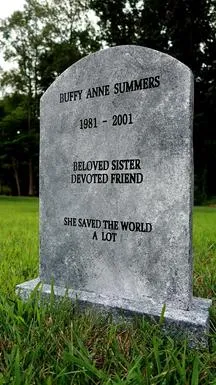
I didn't give Buffy the Vampire Slayer↗ enough credit for doing it several times.
Even going back almost 50 years whilst knowing what the future holds, I couldn't come up with a surefire way to make even a dent in climate change. No victory cheer; where do we go from here?
I think I made a fundamental mistake: I was looking for a single, decisive move. A moment where I could step in, do the Hollywood thing, pull the right lever, and bend history onto a better path.
But climate change doesn’t seem to have a single moment like that. It’s billions of small decisions, made over decades, shaped by incentives, habits, and convictions. Even with perfect knowledge of the future, I wouldn’t get to play this like a chess puzzle with a clever checkmate in three.
And that’s... oddly reassuring?
Because it means the thing I was trying to acquire with time travel isn’t locked behind a science-fiction pill. It’s already here, just a lot less dramatic: conversations, votes, investments, writing, nudges, being an inspiration and example. None of them guaranteed. All of them cumulative.
So yes, I’d still take the red pill. I’d buy the obvious stocks and try to push, in a thousand small ways, toward a slightly better outcome.
Footnote
[1] This is not my original idea; I remember a magician on Dutch TV in the 1980s giving a sealed prediction to a notary before some major event, to be opened afterward. I never saw the reveal, but the prediction was probably correct. They’d be a horrible magician if it wasn’t.
It would be ironic if the whole performance had been an attempt to raise awareness about climate change.