My Compost Bin is Always Almost Empty, Even When It's Full
Introduction
Our back garden ends at a fence that is covered in Hedera (commonly referred to as ivy). If you know anything about gardening, you already know this plant grows quickly and relentlessly. It wraps itself around anything it can reach, and it practically glues itself to any surface. Behind our garden, on public property, are some beautiful, tall trees, some of which are completely enveloped --strangled, almost-- by Hedera.
[Tangent & Spoiler alert] The movie Single White Female (1992) is about a woman, played by Bridget Fonda, who takes in a roommate, played by Jennifer Jason Leigh. The latter gradually takes over the former's life. The name of Leigh's character? Hedra Carlson. When it was released, I read somewhere that this first name is a reference to the plant, but other interpretations are possible. [1]
I don't particularly like gardening, so when I do it, it's usually very necessary. Consequently, when I prune the Hedera, there's a lot of green waste. I use a snow shovel to scoop up that waste, and to push it down the compost bin. But even though it holds 240 litres [2], I can never compress it enough for all the waste to fit. From a physicist's point of view, this never ceases to amuse me [3]. You see...
Atoms
Plants are made of cells. Cells are made of --and I'm taking a huge leap here-- molecules, and molecules are made of atoms. Most of us have seen images of atoms that look similar to this one:
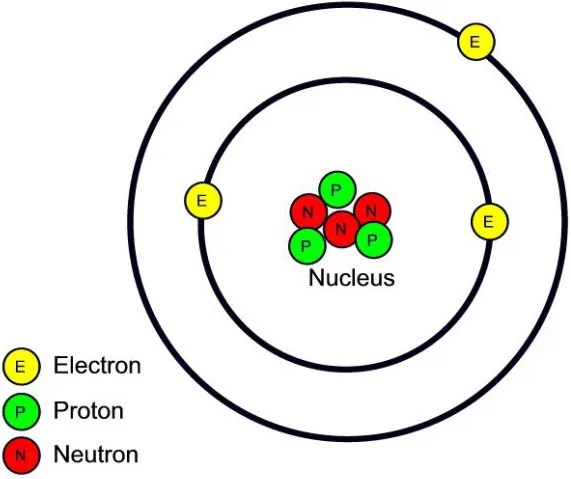
This is the familiar textbook picture of an atom. Unfortunately, textbooks lie. Not maliciously; they simply commit the same crime every map does: sacrificing accuracy so that humans can understand what's going on.
This model depicts electrons, protons, and neutrons as similarly sized spheres. In reality, they are very different: electrons behave like point particles, and the protons and neutrons are so much heavier that the nucleus accounts for over 99.8% of the atom's mass.
The distance between the nucleus and the electrons is actually much larger than depicted. If the nucleus were the size of a baseball, the atom would be the size of the stadium.
Under normal circumstances, nuclei stay far away from each other: the distance between neighboring nuclei is about 20,000 times their diameter! This means that, for example, a scuba tank filled with compressed air still consists mostly of nothingness! (I'm purposefully not using the word vacuum here.)
In a neutron star, this nothingness is mostly gone. Matter has been compressed so intensely that protons and electrons have effectively combined into neutrons and the distance between the neutrons is usually only 1 to 5 times their diameter. If Earth had the same density as a neutron star, it would have a radius of just 150 meters! [4] My compost bin reduced by the same factor would be smaller than the tip of a sewing needle. That's not "quite small," that's "you can hide the compost bin under a grain of sand."
So if you ever see me on all fours in my back garden, blowing away sand, I may be looking for my compost bin. It may now be very small, but it still has the same mass as before, so unlike grains of sand, it won’t easily be blown away.
My compost bin weighs about 10 kg. If I set it on my flat hand, it would hurt, but I’d be fine. Now imagine the same 10 kilograms concentrated onto the point of a sewing needle. The pressure would be enormous: the "bin" would probably puncture right through my hand.
Solar Systems
Looking at the image of the lithium-6 atom above, it's easy to see the resemblance to the following image of our Solar System.
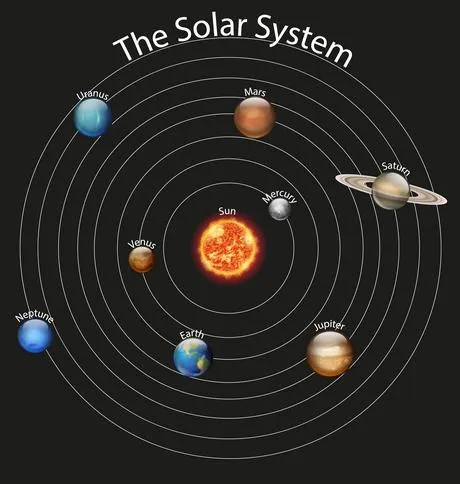
Image source: vecteezy.com
Interestingly, it has similar shortcomings: the Sun is drawn at roughly the same size as the planets orbiting it, even though it's much larger. And as the "nucleus," the Sun holds over 99.8% of the total mass of the Solar System. The distances between the Sun and the planets as shown are too small; also, the distance between two "adjacent" planets increases exponentially as you move from the inner planets to the outer ones.
The Solar to Scale website allows you to scroll downwards from the Sun towards Neptune. Be prepared to spend more and more time scrolling the closer you get to Neptune!
Galaxies
Since around 1900, humanity has been sending radio signals into space as a consequence of transatlantic radio communications that started around that time. Many of those radio signals escaped the Earth's atmosphere at the speed of light [4].
The following image of the Milky Way gives an indication of how far those radio signals have traveled by now. They have been going for little over 125 years in all directions, so the diameter of the green dot is 2 × 125 = 250 light-years. The diameter of the Milky Way is estimated to be about 100,000 light-years. We see the Milky Way as a dense disk of stars, but the radio waves show how much time it takes for information to travel only a tiny fraction of it.
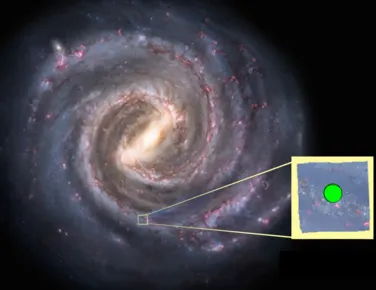
The Milky Way is a galaxy that contains several hundred billion stars; the current estimates are that the observable universe [6] contains somewhere between a few hundred billion and about two trillion (that's 2,000,000,000,000) galaxies -- many of them much larger still than the Milky Way.
An example of such a galaxy is the nearby (relatively speaking!) Andromeda galaxy. Andromeda and the Milky Way are moving toward each other, and in about 4 billion years they are expected to begin merging into a galaxy with more than a trillion stars.
This is a real-time simulation of this merge process:
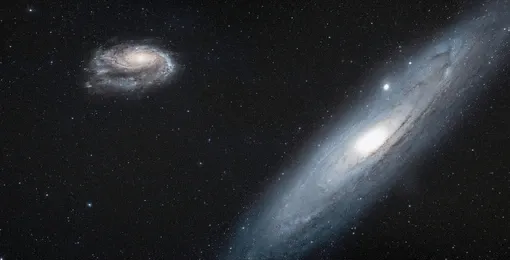
Just kidding! This is merely a still image of the Milky Way and the Andromeda galaxies. However, the distances are so vast that it would be hard to tell a difference between the situation today and one hundred years from now.
Here is an actual simulation of the merge process. It takes only a few seconds, but represents a timespan of billions of years:
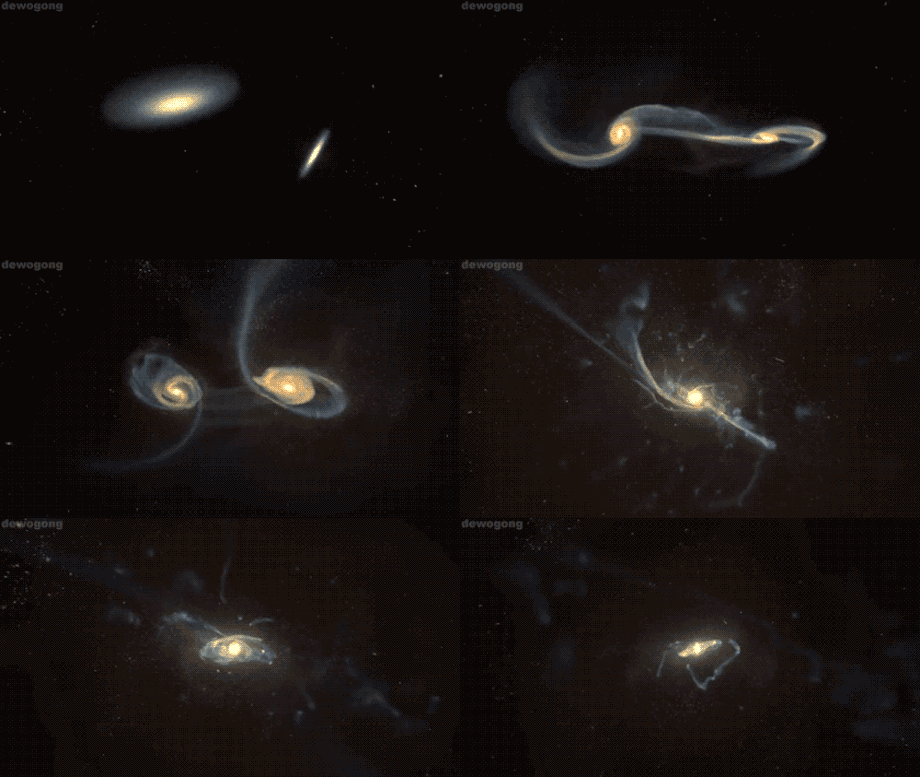
The amazing thing is:
The space between stars inside galaxies is so huge that scientists expect that no stars will collide during the merger.
The Illusion of Solid Ground
If hundreds of billions of stars can pass right through hundreds of billions of other stars without a single collision, it makes you look at the universe a bit differently. Space is overwhelmingly empty. Which brings us to the question: if atoms are mostly empty space, why don’t I fall through my chair right now? If my butt is mostly nothingness, and the seat of this chair is mostly nothingness, shouldn't they just slip right through each other like the Milky Way and Andromeda are expected to do?
When the electrons in the atoms of my pants get too close to the electrons in the atoms of my chair, they don't physically "touch" like billiard balls. Instead, their negative charges violently repel each other. And more importantly, a quantum mechanical rule called the Pauli Exclusion Principle dictates that identical particles can't occupy the same state. When you sit down, you aren't actually touching your chair. You are hovering microscopic fractions of a nanometer above it. The "solidity" you feel is just electromagnetic force fields screaming "KEEP BACK!" at one another.
Which brings me all the way back to my back garden. When I look at my compost bin, full of Hedera leaves, I am looking at an optical illusion. The bin isn't full of green waste. It is full of vast chasms of empty space, held apart by an absurd number of tiny atomic force fields that refuse to let their nuclei get any closer. My compost bin is, quite literally, always almost empty. But Hedera doesn't care about the empty space inside its atoms; it only cares about occupying the empty space in the macroscopic world.
It will find the cracks in my fence. It will climb the trees. And if I don't get back out there with my snow shovel to battle the electromagnetic force fields in my bin, it will eventually come for me and my chair, too.
[1] Including « Ceci n'est qu'un nom. »
[2] 240 litres ≈ 52.7928 UK gallons, 54.4848 US dry gallons, or 63.4008 US liquid gallons. Adapting a famous remark by my former professor Andrew S. Tanenbaum: "The nice thing about gallons is that there are so many to choose from."
[3] I am easily amused.
[4] Several calculations can be found online, based on varying assumptions. All that I came across result in a radius of 150 to 250 meters.
[5] The speed of light, denoted by c, equals 299,792,458 m/s.
[6] Fun, tangential fact: String theory suggests that the ratio between an atom and the observable universe (i.e., the part that we could possibly ever see), may be similar to the ratio between the observable universe and the actual universe. Please, don't just read that line; try to imagine what that means!